# Generalize LMMs to Versatile Visual Modalities via Fabricated Modality Synthesis
S. Yuan, Y. Li, Ruyi Zhang, et al. · ECCV 2026 · Accepted
# Idea
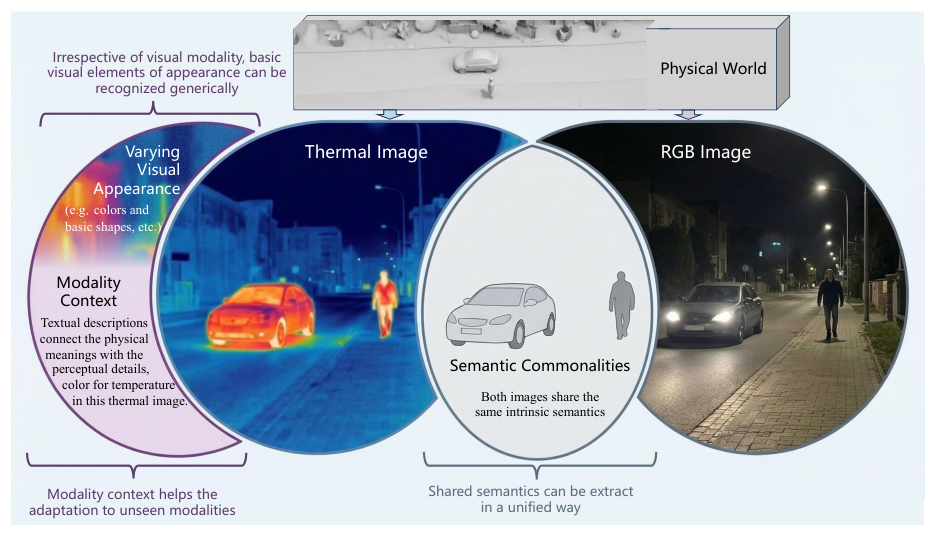
Large Multimodal Models (LMMs) are strong on RGB images, but their ability to generalize to unseen visual modalities (thermal, depth, X-ray and more) is largely unexplored. We argue that different visual modalities are just different samplings of the same physical world. Good generalization therefore needs both modality-agnostic perception of scene semantics and adaptability to modality-specific appearance.
# Method: VVM-Tuning
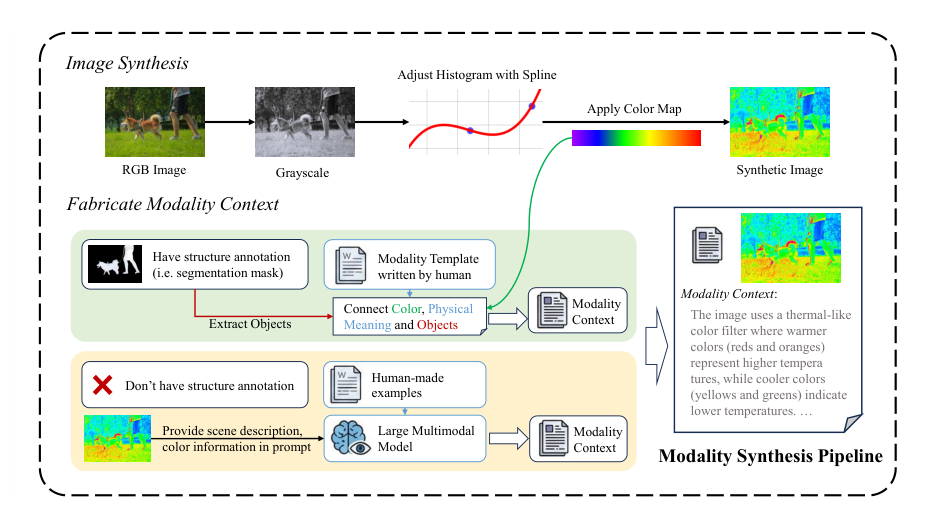
- Modality synthesis: synthesize diverse appearance-varied images from RGB scenes, so the model learns to disentangle invariant semantics from varying appearance.
- Modality contexts: add modality descriptions to the prompt and use instruction tuning to map appearance variations back to modality attributes, enabling zero-shot adaptation at inference.
- VVM-Bench: a benchmark with 6 real and synthetic modalities for semantic perception and modality understanding.
# Results
Trained only on synthetic modalities, 5 tested LMMs (LLaVA-1.5, Qwen-2.5-VL, Qwen-3-VL, …) improve consistently on both real-world and novel synthetic modalities, without any in-modality training.
# My Contribution
Design of the modality synthesis pipeline and zero-shot generalization experiments.
# Generalize LMMs to Versatile Visual Modalities via Fabricated Modality Synthesis
S. Yuan, Y. Li, Ruyi Zhang, et al. · ECCV 2026・已接收
# 核心思想
多模态大模型(LMM)在 RGB 图像上表现出色,但其向未见视觉模态(热红外、深度、X 光等)泛化的能力仍鲜有研究。我们认为,不同的视觉模态本质上是对同一物理世界的不同采样。因此,良好的泛化既需要对场景语义的模态无关感知,也需要对模态特有外观的适应能力。
# 方法:VVM-Tuning
- 模态合成:从 RGB 场景合成外观多样的图像,使模型学会将不变的语义与变化的外观解耦。
- 模态上下文:在提示中加入模态描述,并通过指令微调将外观变化映射回模态属性,从而在推理时实现零样本适应。
- VVM-Bench:包含 6 种真实与合成模态的基准,用于评测语义感知与模态理解能力。
# 实验结果
仅在合成模态上训练,5 个受测 LMM(LLaVA-1.5、Qwen-2.5-VL、Qwen-3-VL 等)在真实模态和新的合成模态上均取得一致提升,且无需任何目标模态内的训练。
# 我的贡献
负责模态合成流程的设计以及零样本泛化实验。